Kitchen Counter Coffee Station Ideas That Don't Take Over
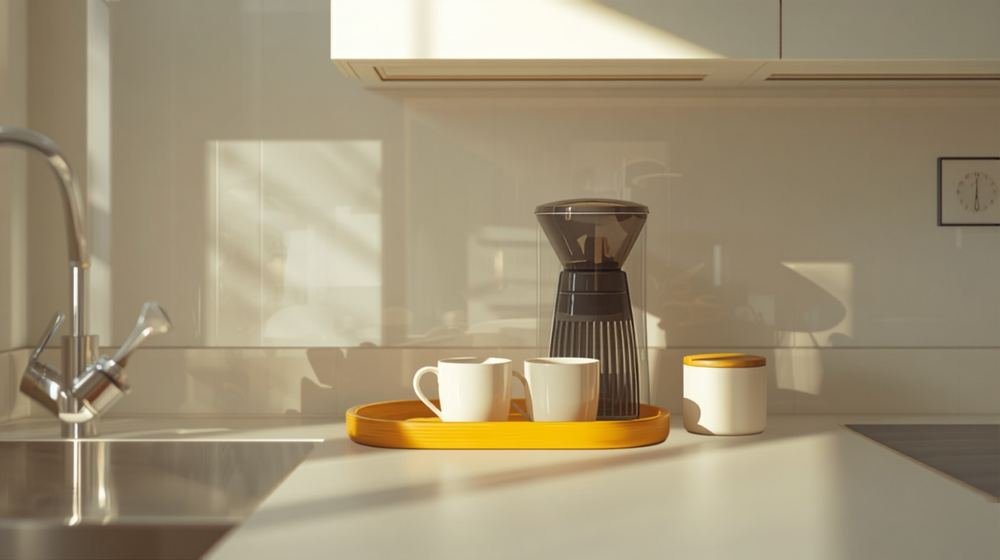
The kitchen counter is the most popular home for a coffee station — and the most contested real estate in the house. The difference between "nice coffee corner" and "why can't I ever prep food anymore" comes down to layout choices, not square footage. Here are the setups that work in real kitchens, cooking included.
Pick the right stretch of counter first
Before any gear moves, audit your counter runs against three rules:
- Near an outlet — obvious, but it eliminates more spots than you'd think.
- Away from the stove. Airborne grease coats machines, steam ages them, and hot pans need landing space. Two feet of separation minimum.
- Outside the cooking triangle. If the station sits between stove, sink, and fridge, every latte collides with every meal. Counter ends and corners keep coffee traffic out of cooking traffic.
The corner station (the classic)
The dead corner where two counter runs meet is usually wasted space — which makes it free real estate. The machine tucks diagonally into the corner, and the two edges fan out mugs, canister, and organizer. Add a corner riser shelf and the corner doubles its storage vertically. This is the single most repeatable kitchen coffee station layout.
Check price on Amazon →The end-cap station
The last 20–24 inches of a counter run, capped by a wall: machine against the wall, tray in front, mugs on hooks on the side wall. Because it sits at the end, the station has a natural boundary — cooking mess stays on its side of the line. If your counters are short, our small-space guide has 27 tighter variations.
The under-cabinet squeeze
Upper cabinets usually leave 17–19 inches of clearance — enough for most drip machines and slim espresso machines (the under-6-inch-wide class we covered in the beginner espresso guide shines here). Mount hooks under the cabinet for mugs and the station consumes almost no visual space. Measure clearance before buying any machine — bean hoppers add height that specs sometimes bury.
The appliance garage takeover
If your kitchen has an appliance garage or a deep corner cabinet with a door, it may be the best coffee station spot in the house: doors open at 7am, doors close at 8, kitchen looks pristine. Run a slim power strip inside and the machine never has to move. One warning: espresso machines need ventilation while running — open the door during use.
The counter-to-wall vertical build
When the counter can only spare 18 inches, take the wall above: one or two floating shelves hold beans, backup mugs, and the decor, while the counter holds only the machine and tray. A rail with S-hooks under the bottom shelf hangs scoops and towels. The station reads big; the footprint stays tiny.
Working around the things kitchens actually have
Guides assume a clean empty counter. Real kitchens have obstacles, and each one has a standard workaround:
- Outlets in the wrong place. Don't run a cord across a prep area — it's the most common kitchen accident there is. Either move the station to the outlet, or use a short under-cabinet power strip mounted out of the splash zone.
- A window above the counter. Actually an advantage: windowsills take canisters and mugs, freeing the counter for the machine. Just keep beans out of direct sunlight — light degrades them faster than air does.
- An awkward corner. The dead diagonal where two runs meet is usually wasted anyway. A corner riser turns it into two usable levels.
- No upper cabinets. Open wall means a floating shelf at 16-18 inches above the counter — high enough to work under, low enough to reach.
- Shallow counters (under 22 inches). Go vertical and skip anything deep. Slim machines under six inches wide exist precisely for this; our beginner espresso guide flags the compact ones.
Keeping it usable when you're actually cooking
The test of a kitchen coffee station isn't how it photographs — it's whether it survives a Sunday roast. Three things make the difference:
- Stay out of the work triangle. If the station sits between stove, sink and fridge, every coffee collides with every meal. Counter ends and corners keep the two traffic patterns apart.
- Two feet from the stove, minimum. Airborne grease coats machines and hoppers, steam ages electronics, and hot pans need landing space. This is the rule people regret ignoring.
- Everything on one liftable base. A tray or board means the whole station moves in one motion when you need the counter — instead of relocating six items individually and never putting them back properly.
Small kitchen? Three layouts that genuinely work
| Counter available | Layout | What fits |
|---|---|---|
| Under 18 inches | Vertical — shelf above, tray below | Slim machine, 2 mugs, one canister |
| 18-24 inches | End-cap against a wall | Machine, tray, organizer, 4 mugs on hooks |
| 24+ inches or a corner | Corner L with a riser | Full station incl. grinder and canisters |
If none of those fit, the station probably shouldn't be on the counter at all — a cart or cabinet elsewhere in the room solves it better. Our small-space guide covers 27 of those layouts, and the cabinet ideas guide covers furniture that takes the whole setup off the counter entirely.
Styling that survives a working kitchen
- Contain everything on a tray or mat. Kitchens are splash zones — a bar mat catches drips and visually declares the boundary.
- Kill the packaging. The cluttered look comes from boxes and bags, not gear. One canister for beans, an organizer for pods and sweeteners, recycling for everything else.
- One accent only. A small plant or a sign — in a room already full of visual noise, restraint is what makes the station read as designed.
- Match the kitchen, not a fantasy. Wood tones with wood kitchens, matte black with modern ones. The station should look like the kitchen grew it — our modern coffee station guide covers the two-material rule that makes this work.
The full checklist
Once the spot is chosen, stock it in tiers — our coffee bar essentials checklist covers the must-haves versus the skippables, and the step-by-step build guide walks the whole process from empty counter to finished station.
Frequently asked questions
Where should a coffee station go in the kitchen?
The best spot satisfies three rules: near an outlet, away from the stove (steam, grease, and heat are gear killers), and outside the main cooking triangle so coffee-making doesn't collide with dinner-making. The end of a counter run — especially a corner — is the classic answer for a reason.
How do I keep a kitchen coffee station from looking cluttered?
Contain it and edit it. A tray or bar mat defines the borders; a canister replaces torn bags; four favorite mugs stay out and the rest go in cupboards. The clutter feeling almost always comes from packaging — boxes and bags — not from the gear itself.
How far should a coffee station be from the stove?
At least two feet. Airborne grease coats machines and bean hoppers, steam shortens the life of electronics, and hot pans need landing space nearby. It's the placement rule people most often ignore and most often regret.
How do I set up a coffee station with no counter space?
Go vertical or go elsewhere. Vertical means a floating shelf 16-18 inches above the counter for beans and mugs, leaving only the machine below — a full station in about 18 inches of width. If even that doesn't fit, move it off the counter entirely to a rolling cart or a small cabinet; that's usually the better answer in a genuinely tight kitchen.
Can I put a coffee station next to the sink?
Adjacent is convenient — water for the tank, somewhere to dump grounds — but leave about a foot of dry buffer. Directly in the splash zone means water spots on the machine and a counter that never quite dries under the tray.
How do I set up a coffee station at home without it taking over the kitchen?
Give it a defined edge and a hard size limit. Put everything on one tray or mat so the station has visible borders, cap it at the width you're genuinely willing to lose — 18 to 24 inches is enough for a full setup — and push storage upward onto a shelf rather than outward along the counter. Then keep only daily items at the station: backup beans, spare mugs and seasonal syrups belong in a cabinet. Stations spread because nothing tells them where to stop.
What should go on a coffee station on the kitchen counter?
Only what you touch daily: the machine, the beans or pods, one or two everyday mugs, and whatever you put in the cup. Everything else — the spare filters, the second grinder, the mug collection — belongs in a cupboard. A kitchen counter station fails on creep, not on design, and the test is simple: if you have not used it this week, it should not be out.
How much counter space does a coffee station need?
Less than most people give it. A drip machine and a small organizer fit comfortably in about 24 inches of run; a pod machine needs closer to 18. What you actually need is clearance, not width — room to swing the water reservoir open, and a few inches above for the lid. Measure upward before you measure sideways.
Can you fit a coffee station in a small kitchen?
Yes, but stop looking for free counter and start looking for a stretch you can take back. The end of a run next to the wall, the strip beside the fridge, or the shelf inside an appliance garage all work. If genuinely nothing is free, move the station off the counter entirely — a narrow cart or a cabinet setup keeps the kitchen usable.