Apartment Coffee Corner Ideas (Renter-Friendly, No Drilling)
Apartment coffee corners have a specific problem that house guides ignore: there is usually no spare counter, the wall may not be yours to drill, and whatever you build is visible from the sofa, the desk and sometimes the bed.
That is a tighter brief than "put a tray on the counter" - but it is a solvable one. Some of the best-looking coffee corners anywhere are in small rentals, precisely because the constraints force editing.
Here is how to build one that works, arranged by the thing that actually limits you.
Step 1: Stop assuming it goes in the kitchen
This is the decision that fixes most apartment coffee corners, and it is usually made wrong. If your kitchen counter is already contested, putting the coffee station there guarantees a daily conflict between coffee and cooking.
Places that work better in a small apartment:
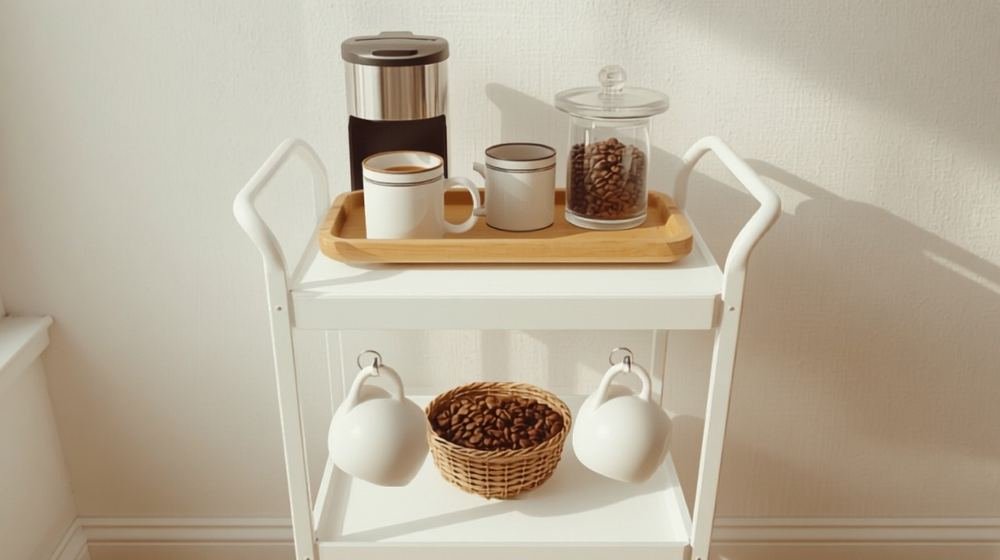
- A rolling cart parked at the end of the kitchen or against a living-room wall. The renter's default for good reason - it needs no mounting, and it moves.
- One shelf of an existing bookcase, ideally at counter height. Commit the whole shelf; half a shelf reads as clutter.
- A dresser or sideboard top, with the drawers below swallowing pods, filters and backup beans.
- A console table behind a sofa or along a hallway wall - narrow, and it makes an otherwise dead wall useful.
- A deep windowsill, which suits a manual pour-over setup beautifully and costs no floor space at all.
Step 2: Define it, or it will not read as a station
In a studio or open-plan flat, the coffee corner is visible from everywhere. Without a defined edge it reads as appliances that have been left out.
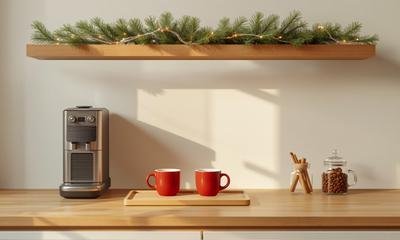
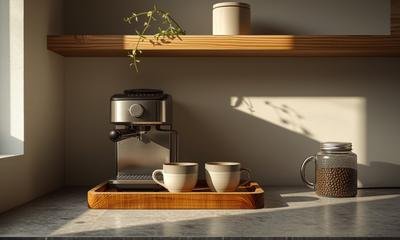
A tray is the entire fix, and it is the highest-impact $25 in this guide. A wooden tray with a raised lip contains the machine, the canister and two mugs, and instantly turns the group into one deliberate object. A bar mat does the same job with better drip resistance if the surface is furniture rather than counter.
The second half of defining it is subtraction: four mugs out, the rest in a cupboard. Our coffee bar decor guide goes further into why containing comes before decorating - and in a small apartment that order matters more, not less.
Check price on Amazon →Step 3: Build upward, because the floor is spoken for
Counter and floor space are the scarce resources in a flat. Wall space usually is not, even in a rental.
- Adhesive hooks for mugs. Removable hooks under a shelf or straight onto the wall. No holes, no deposit risk, and mugs stop eating the surface.
- A freestanding or tension-rod shelf. If drilling is out, a slim shelving unit next to the station gives you height without touching the wall.
- A cart with three tiers. The cart is doing vertical storage for you already - machine on top, daily supplies in the middle, backup below.
- Peel-and-stick tile behind the station. About $30, removable, and it defines the zone architecturally rather than with objects. The single best renter trick in this whole category.
Step 4: Choose gear by footprint, not features
In a small space the machine's width decides more than its spec sheet does.
| If you have… | Go with | Why |
|---|---|---|
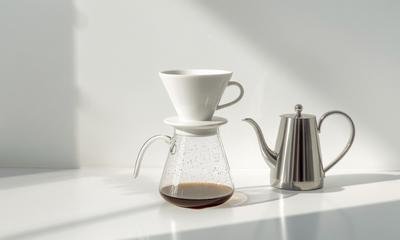
| Under 18 inches | Manual brewing - dripper, kettle, hand grinder | Packs away entirely; no power needed |
| 18-24 inches | A slim espresso machine (around 6 inches wide) | Full espresso in a narrow footprint |
| A cart or dresser top | Drip machine or pod brewer | The surface is yours, so depth stops mattering |
| Shared kitchen, no fixed spot | Everything on one liftable tray | The whole station relocates in one motion |
Two notes worth having before you buy. Slim espresso machines genuinely exist at around six inches wide - our beginner espresso machine guide flags the compact ones. And if you go manual, a hand grinder is not a compromise at this budget: our manual vs electric comparison explains why it usually out-grinds an electric at the same price, while being silent and taking up almost nothing.
Silence is a genuine apartment consideration, incidentally. Thin walls, an early start and an electric grinder is a combination that makes you unpopular.
Step 5: Storage, before it accumulates
Small stations do not get cluttered because of the gear. They get cluttered because of packaging - torn pod boxes, a bean bag with a clip, a sugar bag.
- One airtight canister for beans, on display rather than hidden. Glass looks better than any bag will.
- A tiered organizer if the daily supplies have multiplied - our countertop organizer guide covers which style suits which setup.
- A drawer or basket for backup stock. One week of supplies at the station; everything else out of sight. That one rule prevents most re-cluttering.
- A small basket under a cart or on a shelf, for the things that have no other home.
The renter's checklist
Everything here comes off cleanly when you move:
- Rolling cart - no mounting at all
- Adhesive hooks - mugs, scoops, a towel
- Peel-and-stick backsplash - removable, transformative
- Freestanding shelving or tension rods instead of brackets
- Battery puck lights - no wiring, and they make a dim corner feel intentional
- A tray, so the whole station moves as one object on moving day
Three apartment builds that work
The $35 minimum
Your existing machine, a tray, an airtight canister, and two adhesive hooks for mugs. Genuinely complete - it looks intentional and it took an afternoon.
The $120 cart
A three-tier rolling cart, tray on top, canister and organizer in the middle, backup stock below, hooks on the side rail. This is the most-recommended apartment coffee corner there is, and it is the one that survives a move intact.
The $250 corner
A slim espresso machine, a hand grinder, a cart or console, peel-and-stick tile behind, a shelf above with a puck light. A full espresso setup in under two feet of wall.
What not to bother with in a flat
- A dedicated coffee cabinet. Furniture that only does one job is a poor trade when floor space is the constraint. A cart or an existing dresser does the same work.
- A machine with a large bean hopper, if it lives under cabinets. Measure the clearance, not just the width.
- A full syrup collection. Two bottles, if you actually drink them.
- Anything requiring a second outlet in a room that has one.
- More than one decorative item. When the station is visible from the sofa, restraint is what stops it reading as clutter.
Where to go next
If you want more layouts, our 27 small-space coffee bar ideas covers carts, walls, furniture conversions and windowsills in detail. For the full build sequence from an empty surface, the step-by-step coffee bar guide walks through spot, gear and styling in order, and the essentials checklist settles what actually deserves the space.
And if the corner in question is a desk rather than a home, the office coffee station ideas solve a very similar problem with slightly different rules.
Frequently asked questions
How do I make a coffee corner in a small apartment?
Pick a spot that isn't the kitchen counter if the kitchen counter is contested - a cart, a shelf of an existing bookcase, or the top of a dresser all work. Then define it with a tray, keep only daily items out, and take storage vertical onto the wall. A complete apartment coffee corner fits in about 18 inches of width.
Can I have a coffee bar in a rental?
Yes, and without a single hole in the wall. Adhesive hooks hold mugs, a rolling cart needs no mounting at all, tension rods and freestanding shelving cover storage, and peel-and-stick tile handles the wall behind. Everything comes off cleanly when you move, which is also why a cart is the piece most renters end up glad they bought.
Where should a coffee station go in a studio apartment?
Away from the bed if you can, and near an outlet you're not already fighting over. A cart at the end of a kitchen counter, a console behind a sofa, or a dresser top all beat cramming it into a kitchen that has no spare surface. The advantage of a studio is that the corner can live wherever the outlet is.
How do I stop a small coffee corner from looking cluttered?
Contain before you decorate. A tray draws the boundary, canisters replace packaging, and only four mugs stay out. In a small apartment the station is usually visible from the whole room, so restraint matters more than it would in a separate kitchen - one decorative item, not four.
What's the cheapest way to set up an apartment coffee corner?
Use the machine you own, add a tray and an airtight canister, and put mugs on adhesive hooks. That's roughly $35 and it's genuinely finished. A rolling cart is the next $40-60 if you need the surface itself rather than just organising an existing one.
Do I need a special coffee maker for a small apartment?
No, but width matters more than features. Slim espresso machines around six inches wide exist for exactly this, and manual brewers - a dripper and a hand grinder - take almost no space at all and make excellent coffee. Check the height under your cabinets too, since bean hoppers add clearance that spec sheets often bury.