Manual vs Electric Coffee Grinder: Which Should You Buy?
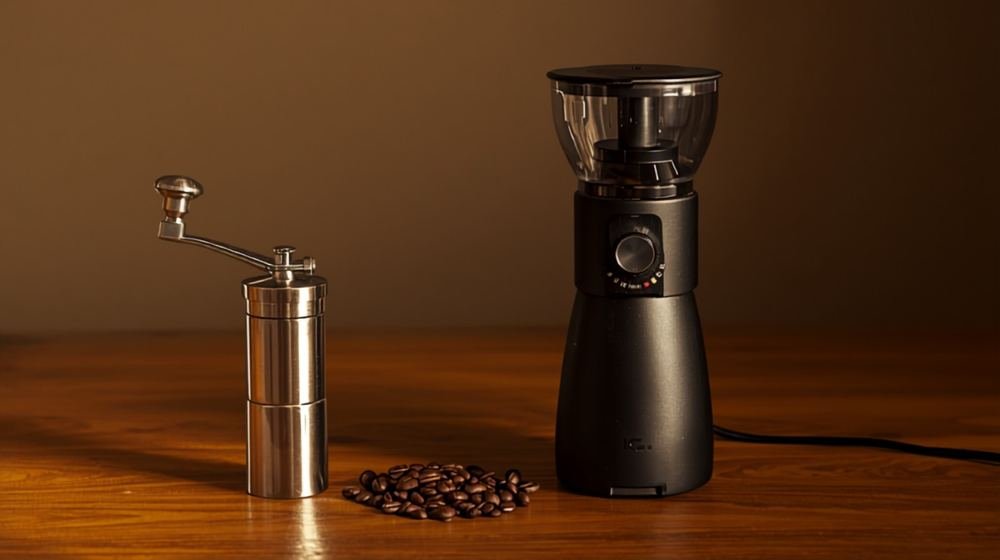
This question usually gets answered with taste-versus-convenience platitudes. The actual answer depends almost entirely on one number: your budget. Below a certain price, manual grinders genuinely make better coffee. Above it, electrics win. Here's where that line sits and why.
The short answer
| Your budget | Buy | Why |
|---|---|---|
| Under $60 | Manual | Cheap electrics at this price are disc-mills with poor consistency |
| $60-150 | Manual for espresso, electric for drip | Depends entirely on your brew method — see below |
| $150-250 | Electric | Good electrics arrive here; convenience starts winning |
| $250+ | Electric | No real contest — quality and speed both |
Why manual wins at low prices
It comes down to where the money goes. A $70 manual grinder spends nearly all of it on burrs — often 38-48mm hardened steel, the same class found in electrics costing three times as much. There's no motor, no housing, no gearbox, no electronics.
A $70 electric grinder has to pay for a motor, a body, a switch, a hopper and a grounds bin. What's left for the burrs is very little, which is why so many budget electrics use stamped disc mills rather than true conical burrs. The result is a wide scatter of particle sizes: dust and boulders in the same dose, extracting unevenly.
Where electric wins
Everything that isn't grind quality:
- Speed. 15-20 seconds versus 30-90. Small on paper, meaningful at 6:30am.
- Effort. Zero. This is the whole point, and it matters more the more coffee you make.
- Capacity. Hoppers hold a whole bag; hand grinders take 20-35g per fill — one or two doses.
- Repeatability. A timer setting gives the same dose every day without thinking about it.
- Multiple drinkers. Grinding for four people by hand stops being a ritual and becomes a chore very quickly.
The honest downsides nobody mentions
Manual
- Espresso grinding is genuinely hard work. Fine grinds mean high resistance — expect 60-90 seconds of real effort per shot, not a gentle stir.
- Wrist and hand strain is real. If you have any joint issues, this is a serious consideration rather than a footnote.
- Small capacity. Refilling mid-grind for a French press is tedious.
- Consistency depends on you. Grinding at an inconsistent speed can vary the result slightly.
Electric
- Loud. Genuinely loud — a real issue in apartments, open-plan homes, or before anyone else is awake.
- Static mess. Grounds cling to the bin and scatter on the counter, particularly in dry weather.
- Retention. Cheap electrics keep several grams of old grounds inside, which go stale and taint the next dose.
- More to break. Motors fail; a hand grinder has almost nothing that can.
Match it to how you actually brew
| You brew… | Recommendation | Reasoning |
|---|---|---|
| Espresso, budget under $150 | Manual, clearly | Only way to get espresso-fine consistency at this price |
| Pour over, one or two cups | Manual works beautifully | Medium grind is easy work; the ritual suits the method |
| Drip, full pot daily | Electric | Larger doses make hand grinding tedious fast |
| French press, large batches | Electric | Coarse grind is forgiving, so cheap electrics are acceptable here |
| Travel / camping / office | Manual | No power needed, packs small, silent |
| Multiple drinkers, mornings | Electric | Volume and speed both matter |
The case for owning both
This is more common than you'd expect among people who take coffee seriously, and it's not indulgent — it's practical. An electric handles the weekday drip pot; a hand grinder handles single weekend pour-overs and travels in a bag. Together they cost less than one good mid-range electric, and each does what it's actually best at.
What to look for, whichever you choose
Manual: steel burrs (not ceramic, which dull differently and grind slower), a click-adjustment mechanism you can count rather than a vague screw, and a body you can actually hold steady — some slim ones are awkward to brace.
Electric: conical burrs rather than a disc mill, gear reduction if you can find it (slower spinning means less heat and quieter operation), and micro-adjustments between settings rather than 18 fixed clicks with nothing in between.
The verdict
- Espresso on a budget: manual, without hesitation. It's the single best value in coffee gear.
- One or two pour-overs a day: manual, and you'll enjoy it.
- Family drip pot every morning: electric. Don't fight it.
- You value silence: manual.
- You value your mornings: electric.
Specific picks in both categories — including the manual grinder that outperforms electrics twice its price — are in our best burr grinders under $100 guide. And whichever you pick, pair it with an airtight canister, because grinding fresh beans that were already stale doesn't help much.
Frequently asked questions
Is a manual grinder better than electric?
At the same price under about $150, usually yes on grind quality - because the money goes into burrs instead of a motor, housing and electronics. Above roughly $200, electrics catch up and then win outright. Below $150 the manual gives you better coffee; the electric gives you your mornings back. That's the real trade.
How long does it take to hand grind coffee?
For drip or pour over, 30-45 seconds for a two-cup dose. For espresso-fine grind, 45-90 seconds and noticeably more effort, because finer grinding means more resistance. If you make one coffee a day it's a pleasant ritual; if you make four, it stops being charming quite quickly.
Are manual coffee grinders worth it for espresso?
Under $100, they're arguably the only sensible choice. Budget electric grinders can't hold consistency at espresso-fine settings, while a $75-100 hand grinder with good steel burrs can. You pay for it in arm work every single shot - but the shots are genuinely better.
Do electric grinders make coffee taste worse?
Not inherently. Cheap ones can, for two reasons: inconsistent particle size, and heat from fast-spinning burrs that drives off aromatics. Quality electrics with gear reduction spin slower and cooler, which is why the good budget picks are the slow ones rather than the fast ones.
Which is quieter, manual or electric?
Manual, by a wide margin - it's essentially silent apart from the sound of beans cracking. That matters more than people expect if you brew before anyone else is awake, or take early calls in a home office. It's one of the most common reasons people switch to manual.