V60 vs Chemex vs French Press: Which Brewer to Buy
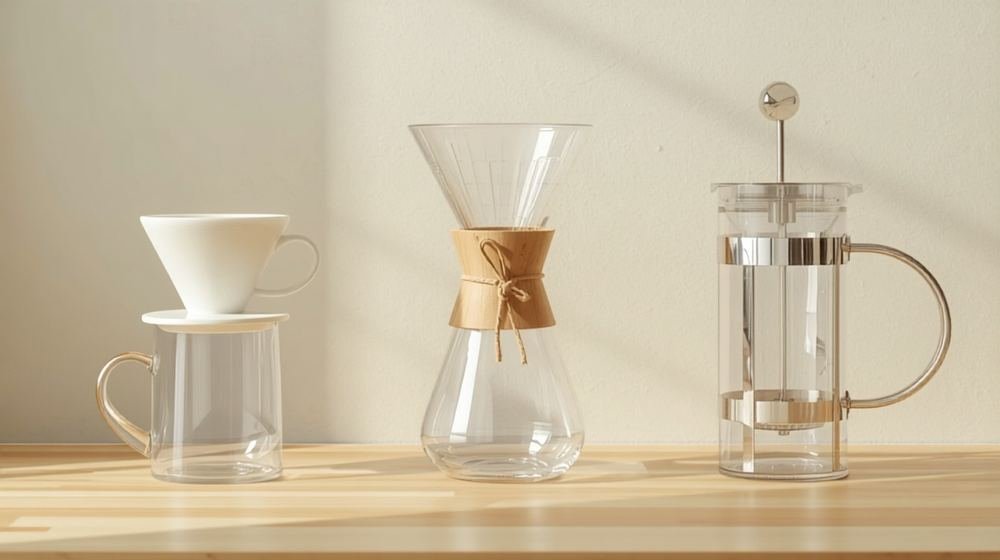
These three brewers get compared constantly, usually on taste alone. But taste is the thing you'll adapt to within a week. What actually determines whether you still use a brewer in six months is how much attention it demands on a Tuesday morning — and that's where they differ most.
The quick comparison
| V60 | Chemex | French Press | |
|---|---|---|---|
| Cup character | Bright, balanced, some body | Cleanest, lightest, tea-like | Heavy, oily, full-bodied |
| Cups per brew | 1-2 | 3-8 | 3-8 |
| Skill needed | High | Medium | Very low |
| Active time | 3-4 min, hands-on | 4-6 min, hands-on | 30 sec + 4 min waiting |
| Gooseneck kettle | Essentially required | Strongly recommended | Not needed |
| Filters | Cheap paper | Proprietary, pricier | None — built-in mesh |
| Cleanup | Easiest | Easy but awkward carafe | Messiest |
| Typical cost | $25-40 | $45-55 | $25-45 |
The V60: control, if you want it
Hario V60 (and clones)
A cone with spiral ridges and one large hole at the bottom. That single hole is the design: water flows out as fast as you pour it in, which means you control extraction — pour rate, pour pattern and timing all change the cup. That's either the appeal or the problem, depending on the person.
Get it right and you get the most nuanced cup of the three, with clarity a French press can't touch and more body than a Chemex. Get it wrong — pour too fast, uneven saturation — and you get sour, thin coffee. There's no autopilot.
- Highest ceiling on cup quality
- Cheapest entry, cheapest filters
- Easiest cleanup of the three
- Small — fits any coffee corner
- Genuinely technique-dependent
- Needs a gooseneck kettle
- 1-2 cups only
- Demands attention every single brew
The Chemex: the clean one that looks the part
Chemex
An hourglass carafe using bonded filters roughly 20-30% thicker than standard paper. Those filters are the whole story: they strip out oils and micro-fines, producing an exceptionally clean, light, almost tea-like cup. People either love that clarity or find it hollow — it's the most polarising cup here.
It's also the one that looks like an object rather than equipment, which is why it ends up on coffee bars as much for the look as the coffee.
- Cleanest cup available from any method
- Brews 3-8 cups, carafe holds it
- Genuinely beautiful on a counter
- More forgiving than V60
- Proprietary filters cost more and you must not run out
- Strips body some drinkers want
- Glass, and the narrow neck is awkward to wash
- Slowest brew of the three
The French press: the one you'll actually use on a Tuesday
French press
Full immersion — grounds steep in water, then a metal mesh separates them. Because the filter is metal rather than paper, oils and fine particles stay in the cup, giving the heaviest body and richest texture of the three. Some sediment at the bottom is normal, not a fault.
Critically, it's the only one of the three that doesn't need you standing over it. Add water, walk away, come back in four minutes. That's why it survives in real kitchens where the V60 quietly moves to the back of a cupboard.
- Almost impossible to get badly wrong
- No filters to buy, ever
- Hands-off for the four minutes
- Richest, fullest body
- Messiest cleanup by a distance
- Sediment in the cup by design
- Needs a genuinely coarse, consistent grind
- Coffee keeps extracting if you don't decant it
The grind requirement nobody mentions upfront
All three depend on grind consistency more than on the brewer itself — and the French press is the fussiest despite being the easiest to operate. It needs a genuinely coarse, even grind; too fine and you get sludge through the mesh plus bitter over-extraction.
This is where budget grinders fail. A cheap disc-mill grinder produces both dust and boulders, which ruins a French press specifically. Our under-$100 grinder guide covers which ones handle coarse well, and our manual vs electric comparison explains why cheap hand grinders often beat cheap electrics here.
So which should you buy?
- You enjoy process and make one cup at a time: V60. Highest ceiling, cheapest to run.
- You want clean, light coffee and often brew for others: Chemex.
- You want good coffee with minimum fuss: French press. This is the honest answer for most people.
- You're buying your first brewer ever: French press. Learn to like coffee before learning technique.
- You already own a French press and want something different: V60 — it's the biggest change in character for the least money.
Where it lives
All three are counter-friendly and none needs power, which makes them ideal for small setups — our small-space coffee bar guide has layouts where a dripper and kettle replace a machine entirely. If you're building the corner around one of these, the step-by-step home coffee bar guide covers the rest of the kit, and the essentials checklist notes which extras actually matter for manual brewing.
Frequently asked questions
What's the difference between V60 and Chemex?
Both are pour-over, but the Chemex uses a much thicker proprietary filter that removes more oils and fine particles - producing a cleaner, lighter cup. The V60 uses thin paper and has a large single hole, so it brews faster, keeps more body, and gives you more control over the outcome. Chemex is also a carafe, so it brews 3-8 cups; the V60 typically brews 1-2.
Which makes the strongest coffee?
French press, by a clear margin - full immersion plus a metal filter means maximum extraction of oils and body. But strong isn't the same as high-caffeine or better; it means heavier and more textured. V60 sits in the middle, Chemex is the lightest and cleanest of the three.
Which is easiest for a beginner?
French press, comfortably. Add coarse grounds, add water, wait four minutes, press. There's no pouring technique and no timing skill. The V60 is the most technique-dependent - a bad pour genuinely produces a bad cup, which frustrates a lot of newcomers.
Do I need a gooseneck kettle?
For V60, effectively yes - a controlled slow pour is most of the technique, and a regular kettle dumps water too fast. For Chemex, strongly recommended for the same reason. For French press, no - you're just filling a container, so any kettle works.
Which one needs the least cleanup?
V60 - lift the paper filter with the grounds inside and bin it, then rinse the cone. Chemex is similar but the carafe is awkward to reach into. French press is the messiest by a distance: wet grounds have to be scooped or rinsed out, and the mesh filter needs disassembling periodically.